If you are questioning the level of difficulty for Data Science for Beginners and whether you are able to start without the technical knowledge, you are in good company. Choosing data science is the new trend for thousands of students, fresh graduates and working professionals across the globe as it integrates problem-solving, technology, and business and offers one of the fastest growing career opportunities worldwide.
The need for Data Scientists, Data Analysts and AI specialists is increasing in different fields, including healthcare, finance, retail, manufacturing, and e-commerce. An added advantage is that beginners can embark on this journey without requirements to be experts in coding and math.
With this guide, you will gain the knowledge you need for Data Science for Beginners regarding skills, learning pathways, career opportunities, tools, salaries, and tips for building a career.
Why Learn Data Science as a Beginner?
Data science is a highly marketable skill in the digital economy. Businesses are producing mass quantities of data and they need workers who can extract insights from the data.
Here are a few reasons Data Science for Beginners is an excellent career choice:
- Earning potential
- Job security
- Ability to work in AI and Machine Learning
- Career flexibility for beginners
Due to companies’ increasing demands for employees with data skills, Data Science for Beginners is one of the more popular paths to take for beginners.
What Is Data Science?
Data Science involves a series of steps like the collection, refinement, and analysis of data, followed by the application of the analyzed data to address problems and aid the decision-making process.
Common data science practices consist of the following steps:
- Data Collection
- Data Cleaning
- Data Analysis
- Data Visualization
- Machine Learning
- Model Deployment
Data Science for Beginners: Learning these fundamentals has students confident and ready to tackle advanced data science concepts.
Can Beginners Learn Data Science?
Absolutely. It is a fallacy to think that Data Scientists are solely composed of ex-software Developers. In fact, many Data Scientists have backgrounds in Commerce, Arts, Sciences, Business and non-Steemit professions.
With the right mindset, learning Data Science for Beginners is definitely not out of reach.
Many successful professionals started their journey with Data Science for Beginners and gradually became Data Analysts, Machine Learning Engineers, and AI Specialists.
Essential Data Science Skills for Beginners
Here are some of the primary skills to concentrate on.
Programming in Python
It is the most widely used programming language in Data Science, and there are many super easy to learn libraries for Python.
Some concepts to get familiar with are:
- Variables
- Loops
- Functions
- Lists
- Dictionaries
- File Handling
Statistics and Mathematics
Understanding some basic Statistics helps in the understanding of the trends, patterns and probabilities in the data. As a beginner some of the simplest topics that are helpful are:
- Mean
- Median
- Mode
- Correlation
- Regression
Understanding statistics is an important part of Data Science for Beginners, as it helps in making accurate business decisions using data.
SQL
SQL is very essential when it comes to the management and retrieval of data in structured databases.
Key components:
- SELECT
- WHERE
- GROUP BY
- JOIN
- ORDER BY
Data Visualization
Information visualization allows businesses to interpret data and understand patterns more quickly.
Widely used tools:
- Power BI
- Tableau
- Excel
- Matplotlib
- Seaborn
Machine Learning Basics
Machine Learning is a method to enable a computer to learn by recognizing patterns to make decisions and predictions.
Beginner concepts include:
- Supervised Learning
- Unsupervised Learning
- Classification
- Regression
- Model Evaluation
Data Science Roadmap for Beginners
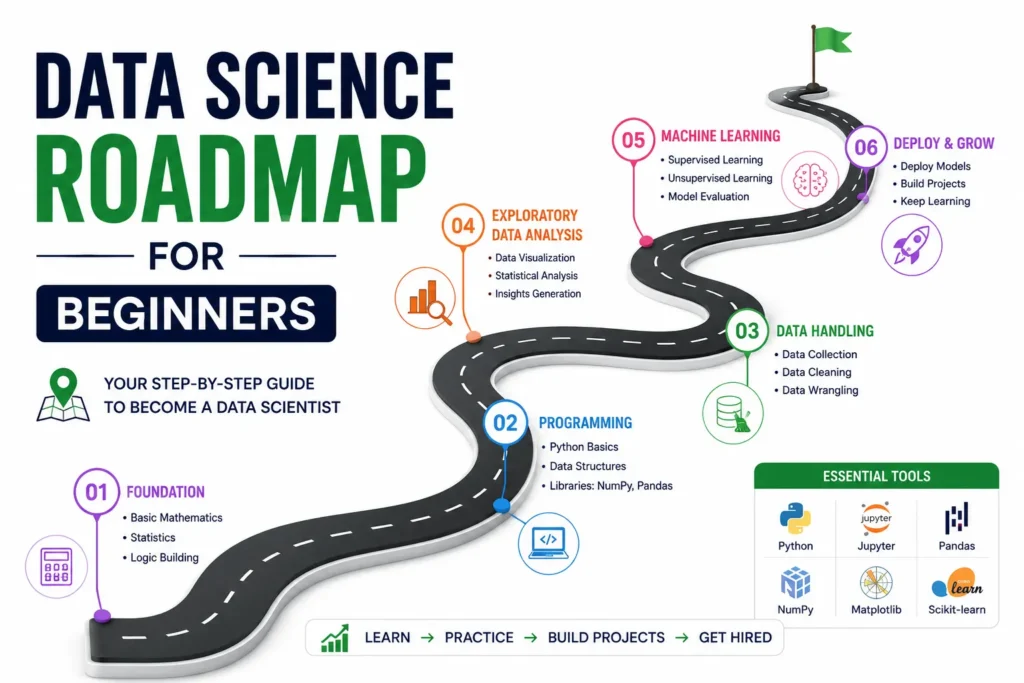
Learning a skill is easier with a clear pathway or roadmap.
Step 1: Learn Python
The basics of programming and a constant practice of programming are required.
Step 2: Learn SQL
Learn database management and how to extract information from a database.
Step 3: Study Statistics
Understanding the basics of statistics is necessary.
Step 4: Learn Data Visualization
The ability to create dashboards and charts to present information is required.
Step 5: Learn Machine Learning
Step 6: Build Projects
Step 7: Create a Portfolio
Best Tools for Data Science Beginners
Building real-world projects is one of the most important stages of Data Science for Beginners because employers value practical experience.
Every beginner should get familiar with these tools:
- Python
- Jupyter Notebook
- NumPy
- Pandas
- Matplotlib
- Seaborn
- SQL
- Power BI
- Tableau
- Git & GitHub
- Excel
- Google Colab
Practicing these tools regularly will strengthen your Data Science for Beginners journey and improve your job readiness.
Job Openings That are Available For You After You Learn Data Science
Once your learning journey is complete, you can apply to be any of the following:
- Data Analyst
- Junior Data Scientist
- Business Analyst
- AI Engineer
- Machine Learning Engineer
- Business Intelligence Analyst
- Data Engineer
- Research Analyst
You can find these jobs at startups, multinational companies, consulting companies, healthcare and banking and logistics and technology companies.
Salary for a Data Science Job in India
Although salaries can depend on skills, experience, and location, Data Science Jobs can be some of the best paying jobs in technology.
Career Level and Earning Potential
- Entry Level — High salaries to start
- Mid-Level — Salaries increase significantly
- Senior Level — Salaries are high and include a benefits package
Completing Data Science for Beginners with practical projects and certifications can significantly improve your career opportunities.
How to Learn Data Science Faster
If you want to learn Data Science For Beginners more quickly, do the following:
- Code daily.
- Complete a project after each module.
- Be a part of Kaggle competitions.
- Study case studies.
- Learn from datasets.
- Practice and develop your skills better.
- Work on projects and maintain a GitHub portfolio.
- Keep abreast with new trends in AI.
- Regular, periodical revisions.
- Keep practicing for Data Science interviews.
Consistency is the key to succeeding in Data Science for Beginners, so practice regularly and continue improving your technical skills.
Beginner Pitfalls
New learners tend to struggle because they make the same mistakes.
Avoid these when learning:
- Too many tools at once.
- Disregarding fundaments of Python.
- Ignoring SQL completely.
- No projects.
- Practice disappears and memorization takes over.
- Wanting to quit after a few hard lessons.
- Avoiding statistics.
- No portfolio.
Following a structured learning path makes Data Science for Beginners easier, faster, and more effective for every learner.
Benefits of a Scheduled Data Science Course
Though it is possible to learn independently, a lot of beginners benefit from a guided learning approach.
An effective program must offer each of the following:
- A curriculum with an industry focus
- Live Projects
- Expert Mentors
- Career Guidance
- Resume Preparation
- Mock Interviews
- Placement Support
- Practical Assignments
A well-designed training program helps learners complete Data Science for Beginners with confidence and industry-ready skills.
In Conclusion
There’s no better idea in 2026 than learning Data Science for Beginners. Artificial Intelligence, Machine Learning, and Business Analytics are pathways that require professionals to use data derived from different domains for making decisions. Data Science helps in creating and using technologies to implement that data.
You should focus on learning Python, SQL, statistics, and data visualization to create projects and grow your confidence and your portfolio. Pursue further and learn higher concepts and advanced data science.
Starting to learn now will ensure that you are a beginner, fresher, or an experienced data science professional with skills and knowledge that boasts a promising career and growth for years to come.
Whether you are a student, graduate, or working professional, Data Science for Beginners offers endless opportunities to build a rewarding career in the technology industry.
FAQs
Can Beginners Learn Data Science?
For Beginners to Data Science, you require a plan and practicing on the plan. Learning data science isn’t technical so everyone has access to.
Is Coding Necessary in Data Science?
You will need to have a basic understanding of a programming language. The entry-level programming language recommended for beginners is Python.
Can a Non-IT Student Become a Data Scientist?
Without a doubt. Students from every domain can learn Data Science.
How Long Will it Take to Become a Data Scientist?
Data Science can be learned in a few months of dedicated study with a focus on project work and practice.
What is the Best Programming Language for Data Science?
Python is generally agreed to be the best Programming Language for Data Science due to its simplicity and the wide array of libraries available.
We hope this guide on Data Science for Beginners has helped you understand how to start your learning journey and build a successful career in data science.