Introduction
Data Science Roadmap: Learn Python, statistics, data analysis, and machine learning, then apply your skills to real-world projects to become a data scientist.
The 6-Step Roadmap
- Foundations: Master Python, SQL, and basic Statistics.
- Prediction: Learn Machine Learning and forecasting.
- Deployment: Learn how to put models into real-world use via APIs.
- Experience: Gain skills through internships and team projects.
- Specialization: Choose a path like NLP or Computer Vision.
- Advanced AI: Explore Generative AI and new tech.
This step-by-step Data Science Roadmap 2026 will guide beginners on how to start and move forward confidently in their data science journey.
What is Data Science ?
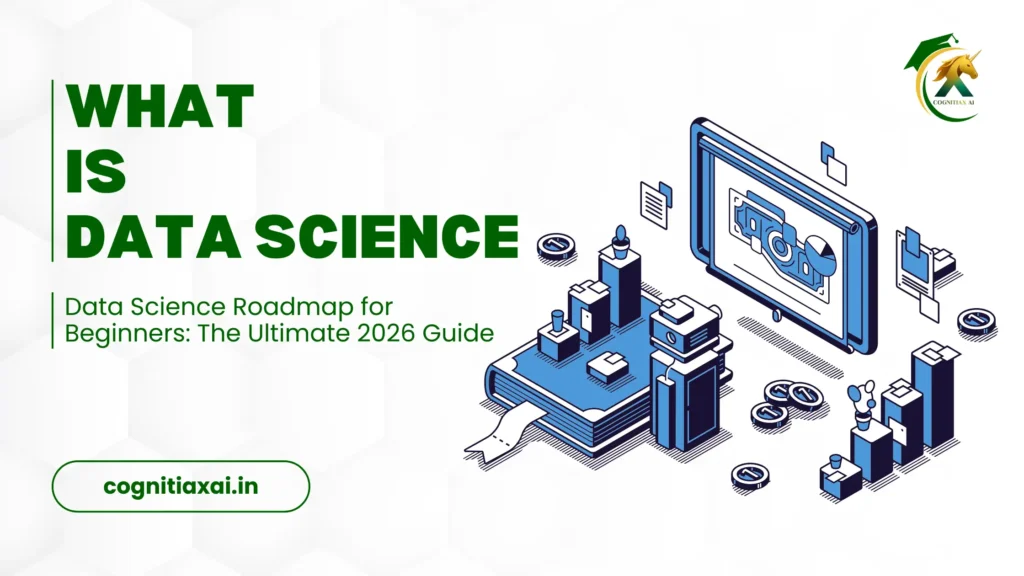
Data Science is the study of data used to obtain clear insights to support business decisions. It includes data collection, data cleaning, data analysis, data visualization and decision making.
Today, data science is used across various industries from healthcare to finance. Through data science, businesses and individuals can predict future outcomes, improve performance, and make smarter decisions based on facts rather than guesses.
For example, by analysing large organizational datasets, data science can provide answers to questions such as:
- What do customers want?
- How can we improve our services?
- What are the expected future trends in sales?
- How much inventory is required for the upcoming festival.
Understanding the Importance of Data Science ?
1. Supports Informed Decisions : Data Science helps organizations make informed decisions by analysing data. Businesses can understand trends and make informed decisions that reduce risk and maximise profit.
2. Improves Business Efficiency : Data Science helps organizations to identify areas where they can save time and resources and improves overall performance by identifying patterns and trends.
3. High Demand Across Industries : Data Science professionals are required in almost every industry, including IT, finance, healthcare, e-commerce, and marketing, making it a good career option.
4. Foretells Future: Organizations use data to make inferences about the future demand and the trends that arise.
5. Good Career Development and Remuneration: With the growing need of skilled professionals, Data Science has great opportunity for career development and competitive salary scales.
What is the ideal Data Science Roadmap?
Although every learner’s journey looks different, here’s an organized roadmap designed for those starting from the beginning and studying part-time.
The 6-Step Roadmap
1. Foundations: Master Python, SQL, and basic Statistics.
The initial stage in becoming a data scientist is developing a solid base. Beginners should begin with learning programming languages such as Python and a database query language SQL. In addition to the use of coding, it is essential to learn the basics of statistics like mean, median, probability, and distributions. These are the basics that helps in the analysis and interpretation of data in the right way.
2. Prediction: Learn Machine Learning and forecasting.
Once the basics are clear, one should go on to study Machine Learning. This includes the training of models and prediction of the same using past data. Simple algorithms, such as linear regression, decision trees, and classification models can be used as a beginner. Such methods aid companies in predicting the trend, customer behaviour and future projections.
3. Deployment: Learn how to put models into real-world use via APIs.
The ability to implement machine learning models is an essential part of learning. The deployment refers to actual implementation of your model by means of APIs or web applications. This assists companies to automate their decision-making and incorporate information-driven solutions within their systems.
4. Experience: Gain skills through internships and team projects.
Work experience is necessary to be job-ready. Beginners should practice on real-life data, internship or project team work. It assists in understanding business issues, data cleaning, visualization, and model construction in practical settings.
5. Specialization: Choose a path like NLP or Computer Vision.
Having experience, learners are supposed to choose a specialization, which depends on their interest. The common areas are Natural Language Processing (NLP), Computer Vision, Data Analytics or Business Intelligence. Specialization helps in building deep expertise and better career opportunities.
6. Advanced AI: Explore Generative AI and new tech.
The last step is to explore with the further ideas, including Generative AI, deep learning, and AI-based applications. The future of data science involves technologies such as OpenAI models and automation platforms. Learning these skills keeps professionals updated with industry trends and the future job requirements.
Final Thoughts :
This roadmap helps you move from basics to advanced skills at a steady pace. By consistently learning Python, machine learning and real-world project development you can build a strong foundation for a successful Data Science Career.
Ready to start? Join the Data Science course at CognitiaX AI to become job-ready in 2026.

 Request Callback
 Say Hi! on WhatsApp