Data is one of the most precious assets that a company could have in today’s digital-first economy. All interactions with customers, online transactions, social media interactions, and business processes create data that can be used to gain insights. This is where the role of Data Science in Business comes in.
Data science is no longer limited to technology companies or research institutions. Regardless of their size, businesses are turning to data science to boost their decision-making process, derive customer experience, optimize their operations, and give them an edge over their competitors. Digital transformation remains a trend for companies, and the ability to derive insights from data has become a pivotal factor in driving success.
This article explores how Data Science in Business is reshaping industries, improving organizational performance, and defining the future of modern enterprises
What Is Data Science in Business?
Data Science in Business is about using statistical analysis, machine learning, AI, and visualization to address business challenges and inform strategic decisions.
Data science can be used to analyze data and uncover patterns, make predictions, and make informed decisions, rather than relying on intuition or past experience.
Data science combines several disciplines, including:
- Statistics
- Machine Learning
- Artificial Intelligence
- Data Engineering
- Data Visualization
- Business Analytics
These disciplines can work together to help organisations convert raw data into business intelligence in action.
Why Data Science Matters More Than Ever
The total volume of data that is available in the world has increased at a rapid pace. Businesses create vast amounts of data every day, from websites and mobile apps to customer transactions and connected devices.
This data is not utilized and has little value if not analyzed properly. Data science empowers organizations to harness this information for strategic insights and growth opportunities.
Businesses that effectively leverage data science can:
- Improve decision-making
- Increase operational efficiency
- Reduce costs
- Enhance customer satisfaction
- Identify new market opportunities
- Predict future trends
With the competition getting tougher in every domain, businesses that use data-centric strategies will outperform businesses that stick to traditional strategies.
How Data Science in Business Improves Decision-Making
The ultimate advantage of data science is one that it can bring to the decision-making process.
The classic approaches to business decisions would be made based on assumptions, experience or a small amount of information. Executives can get up-to-the-minute information with in-depth data analysis.
For instance, retail businesses can use customer buying tendencies to figure out what kinds of products are more likely to be sold in certain seasons. Financial institutions can determine the risk level before they give a loan. Marketing teams can determine on which campaigns they are getting the most ROI.
Data science allows organizations to make informed decisions, mitigating uncertainty and enhancing results.
Enhancing Customer Experience Through Data Science
Customers in the modern era are expecting customization. Companies that are able to provide more relevant products, services, and communications are businesses that know their customers’ preferences and behaviors.
Data science can help businesses understand what drives customer behavior through data analysis and patterns.
Popular applications include:
- Personalized product recommendations
- Customer segmentation
- Targeted marketing campaigns
- Customer journey analysis
- Sentiment analysis
Advanced data science models are employed by many businesses to suggest products and content through user actions, such as e-commerce platforms and streaming services.
This customization helps boost customer satisfaction, engagement and loyalty.
Data Science and Predictive Analytics
Data Science in Business applications has one of the most potent uses, that of predictive analytics.
Historical data allows businesses to identify trends and patterns and make informed predictions about future events and trends.
Predictive analytics can help organizations:
- Forecast sales trends
- Predict customer churn
- Optimize inventory management
- Anticipate market demand
- Detect fraudulent activities
Instead of waiting for events to happen, businesses can take action based on the predictions of what is likely to happen in the future.
This predictive capability gives organizations a substantial competitive advantage in rapidly changing markets.
Operational Efficiency and Process Optimization
All businesses are interested in getting things done with less and less effort. Data science can be used to uncover inefficiencies and optimise processes.
By examining the data from the operations, organisations can identify areas of improvement, resource constraints, and bottlenecks to focus on.
Examples include:
- Supply chain optimization
- Workforce planning
- Inventory management
- Manufacturing quality control
- Logistics optimization
By leveraging data-driven insights, companies can streamline operations, improve productivity, and maximize profitability.
The Role of Machine Learning in Business Growth
Machine learning is a key component of modern data science initiatives.
Machine learning algorithms can analyze vast datasets, recognize patterns, and continuously improve predictions without explicit programming.
Businesses use machine learning for:
- Fraud detection
- Customer behavior analysis
- Dynamic pricing
- Demand forecasting
- Recommendation systems
- Risk assessment
As machine learning technology advances, organizations can automate increasingly complex tasks and generate deeper business insights.
This automation enables employees to focus on strategic initiatives rather than repetitive manual processes.
Data Science in Marketing
Marketing has become one of the most data-driven functions within modern organizations.
Data science helps marketers understand consumer behavior, measure campaign performance, and optimize marketing strategies.
Applications include:
- Audience segmentation
- Marketing attribution analysis
- Customer lifetime value prediction
- Content performance analysis
- Conversion rate optimization
By analyzing customer interactions across multiple channels, businesses can deliver highly targeted campaigns that improve engagement and return on investment.
Data science also helps marketers identify emerging trends and adapt strategies quickly.
Industry Applications of Data Science
The impact of Data Science in Business extends across virtually every industry.
Healthcare
Healthcare providers use data science to improve patient outcomes, optimize treatment plans, and predict disease risks.
Applications include:
- Medical image analysis
- Disease prediction
- Personalized medicine
- Hospital resource management
Finance
Financial institutions rely on data science for:
- Fraud detection
- Credit risk assessment
- Portfolio optimization
- Algorithmic trading
Retail and E-commerce
Retailers use data science to:
- Forecast demand
- Optimize pricing
- Improve inventory management
- Personalize customer experiences
Manufacturing
Manufacturers leverage data science for:
- Predictive maintenance
- Quality assurance
- Production optimization
- Supply chain management
Across industries, data science is helping organizations make smarter decisions and operate more effectively.
Challenges of Implementing Data Science in Business
Despite its advantages, implementing data science initiatives can present challenges.
Some common obstacles include:
Data Quality Issues
Poor-quality data can lead to inaccurate insights and unreliable predictions.
Talent Shortages
Many organizations struggle to find skilled data scientists, analysts, and machine learning engineers.
Data Privacy Concerns
Businesses must comply with regulations while protecting sensitive customer information.
Integration Challenges
Integrating data science solutions with existing systems can be complex and resource-intensive.
Organizations that successfully address these challenges are more likely to realize the full value of their data assets.
The Future of Data Science in Business
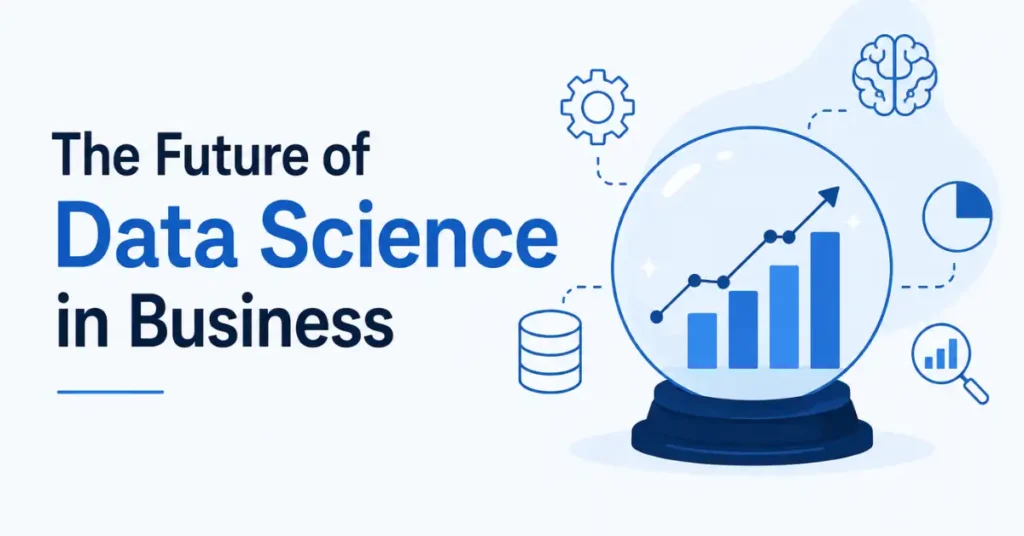
The future of Data Science in Business is closely tied to advancements in artificial intelligence, automation, and cloud computing.
Several trends are expected to shape the next phase of business transformation:
Generative AI Integration
Organizations are increasingly combining generative AI with data science to automate reporting, content creation, and data analysis.
Real-Time Analytics
Businesses are moving toward real-time decision-making powered by continuously updated data streams.
Explainable AI
Companies are demanding greater transparency in machine learning models to improve trust and accountability.
Automated Machine Learning
AutoML solutions are making advanced analytics accessible to non-technical users.
Data Democratization
More employees across organizations will gain access to analytics tools and insights, enabling broader data-driven decision-making.
These developments will continue to expand the role of data science as a strategic business function.
Conclusion
Data Science in Business has evolved from a competitive advantage into a business necessity. Organizations that effectively harness data can improve decision-making, enhance customer experiences, optimize operations, and identify new growth opportunities.
From predictive analytics and machine learning to customer personalization and operational efficiency, data science is transforming how businesses operate in the digital age.
As technology continues to advance, the importance of data-driven strategies will only increase. Companies that invest in data science capabilities today will be better positioned to adapt, innovate, and succeed in an increasingly competitive marketplace.
The future belongs to organizations that can transform data into actionable intelligence—and data science is the key to making that transformation possible.